ASIET Emergency Response Team
Rapid response for mold, moisture, VOCs, odors, and indoor air quality events in colleges, schools, and buildings.
Focus areas: Mold, VOCs, odors, and air quality.
Respond fast. Control the environment. Document everything. Support recovery.
Prepared for campus leaders, school officials, facility managers, property owners, and risk teams.
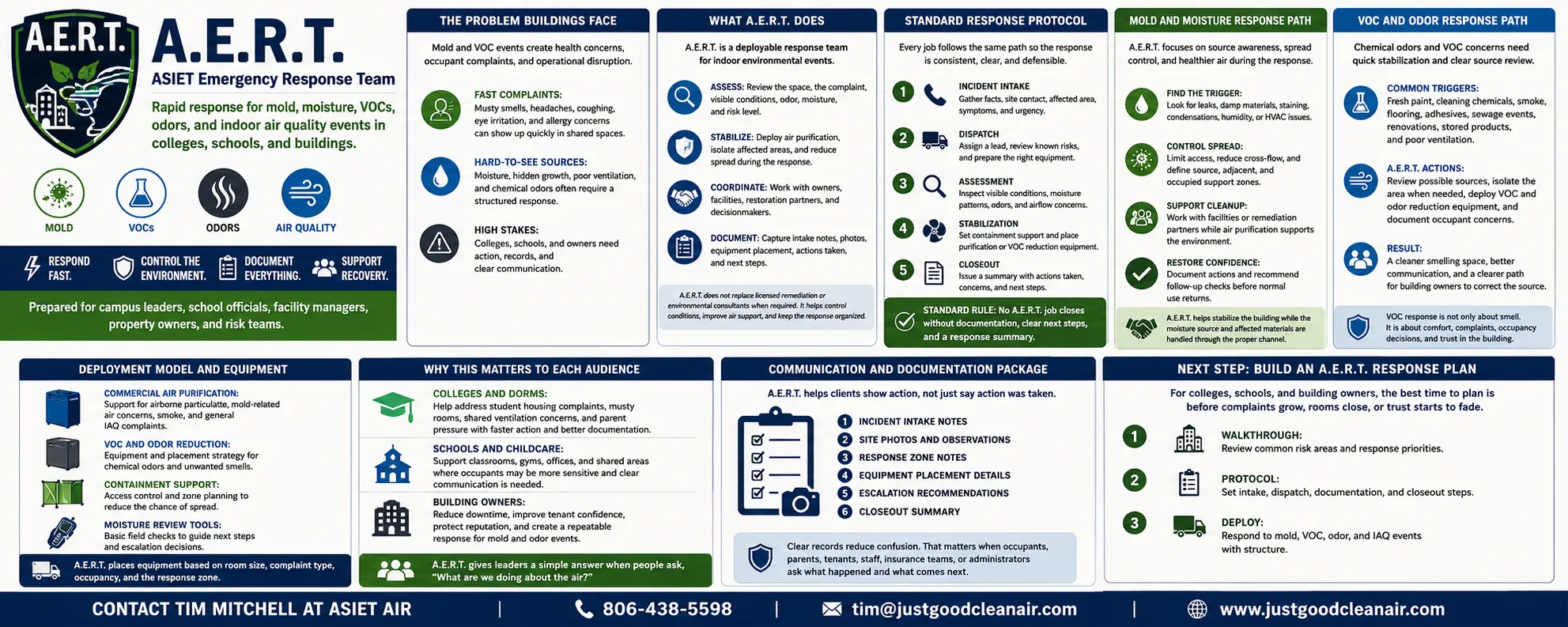
Mold and VOC events create health concerns, occupant complaints, and operational disruption.
Fast complaints: Musty smells, headaches, coughing, eye irritation, and allergy concerns can show up quickly in shared spaces.
Hard-to-seesources: Moisture, hidden growth, poor ventilation, and chemical odors often require a structured response.
High stakes: Colleges, schools, and owners need action, records, and clear communication.
A.E.R.T. is a deployable response team for indoor environmental events.
Assess: Review the space, the complaint, visible conditions, odor, moisture, and risk level.
Stabilize:Deploy air purification, isolate affected areas, and reduce spread during the response.
Coordinate: Work with owners, facilities, restoration partners, and decisionmakers.
Document: Capture intake notes, photos, equipment placement, actions taken, and next steps.
A.E.R.T. does not replace licensed remediation or environmental consultants when required. It helps control conditions, improve air support, and keep the response organized.
Every job follows the same path so the response is consistent, clear, and defensible.
1. Incident Intake: Gather facts, site contact, affected area, symptoms, and urgency.
2. Dispatch: Assign a lead, review known risks, and prepare the right equipment.
3. Assessment: Inspect visible conditions, moisture patterns, odors, and airflow concerns.
4. Stabilization: Set containment support and place purification or VOC reduction equipment.
5. Closeout: Issue a summary with actions taken, concerns, and next steps.
Standard rule: No A.E.R.T. job closes without documentation, clear next steps, anda response summary.
A.E.R.T. focuses on source awareness, spread control, and healthier air during the response.
Find the trigger: Look for leaks, damp materials, staining, condensation, humidity, or HVAC issues.
Control spread: Limit access, reduce cross-flow, and define source, adjacent,and occupied support zones.
Support cleanup: Work with facilities or remediation partners while air purification supports the environment.
Restore confidence: Document actions and recommend follow-up checks before normal use returns.
A.E.R.T. helps stabilize the building while the moisture source and affected materials are handled through the proper channel.
Chemical odors and VOC concerns need quick stabilization and clear source review.
Common triggers: Fresh paint, cleaning chemicals, smoke, flooring, adhesives, sewage events, renovations, stored products, and poor ventilation.
A.E.R.T. actions: Review possible sources, isolate the area when needed, deploy VOC and odor reduction equipment, and document occupant concerns.
Result: A cleaner smelling space, better communication, and a clearer pathfor building owners to correct the source.
VOC response is not only about smell. It is about comfort, complaints, occupancy decisions, and trust in the building.
A.E.R.T. is designed to arrive prepared, place equipment with purpose, and support recovery.
Commercialair purification: Support for airborne particulate, mold-related airconcerns, smoke, and general IAQ complaints.
VOC and odor reduction: Equipment and placement strategy for chemical odors and unwanted smells.
Containment support: Access control and zone planning to reduce the chance of spread.
Moisture review tools: Basic field checks to guide next steps and escalation decisions.
A.E.R.T. places equipment based on room size, complaint type, occupancy, andthe response zone.
The same response model creates value for campuses, schools, owners, and facility teams.
Colleges and dorms: Help address student housing complaints, musty rooms, shared ventilation concerns, and parent pressure with faster actionand better documentation.
Schools and childcare: Support classrooms, gyms, offices, and shared areas where occupants may be more sensitive and clear communication is needed.
Building owners: Reduce downtime, improve tenant confidence, protectreputation, and create a repeatable response for mold and odor events.
A.E.R.T. gives leaders a simple answer when people ask, "What are wedoing about the air?"
A.E.R.T. helps clients show action, not just say action was taken.
Every response can include:
1. Incident intake notes
2. Site photos and observations
3. Response zone notes
4. Equipment placement details
5. Escalation recommendations
6. Closeout summary
Clear records reduce confusion. That matters when occupants, parents, tenants, staff, insurance teams, or administrators ask what happenedand what comes next.
Buildan A.E.R.T. response plan before the next IAQ event.
For colleges, schools, and building owners, the best time to plan is before complaints grow, rooms close, or trust starts to fade.
1. Walkthrough: Review common risk areas and response priorities.
2. Protocol: Set intake, dispatch, documentation, and closeout steps.
3. Deploy: Respond to mold, VOC, odor, and IAQ events with structure.
Contact Tim Mitchell at ASIET Air
806-438-5598 | tim@justgoodcleanair.com | www.justgoodcleanair.com
© Copyright 2025 ASIET AIR - All Rights Reserved - Return Policy - Website Design by Five Dog Solutions


